The Living Centre
On Art, Warmth and the Ensouling of Intelligence
The Living Centre
On Art, Warmth and the Ensouling of Intelligence
The Living Centre
On Art, Warmth and the Ensouling of Intelligence
Date
Date
March 2nd, 2026
March 2nd, 2026
March 2nd, 2026
Written
Written
Jason McDonald
Jason McDonald
Jason McDonald
We have seemingly produced the most intelligent civilisation in human history.
It cannot feel what it knows.
We have cracked the atom, measured time to the trillionth of a second and built machines that beat us at our own languages. We have sharpened the human intellect to a point of extraordinary precision. And we have done so by systematically stripping it of the one quality that makes intelligence worth having ~ warmth.
Not warmth as sentiment. Not warmth as kindness (though that too is haemorrhaging). Warmth as a property of consciousness itself. The quality that allows knowing and perception to become encounter. A living exchange.
The difference between counting the stars and being counted among them.
Between measuring the weight of rain and walking out into it.
Between narrating existence, and trembling with it.
Materialism is the name we give to this condition, but that word has become too polite, too academic, too easily filed under “worldview” and set aside. What we are actually living inside is a perceptual winter. The intellect, unmoored from soul, has frozen the world into data, resource, and mechanism. And the freezing has become so ambient, so structural, so woven into the way we educate and build and transact, that most of us no longer feel the cold. We simply assume this is what the air is supposed to feel like.
It is not.
And the ones who sense this most clearly, who have never quite surrendered to it, who go on holding something living where others have stopped looking ~ are the artists.
I’m going to be purposely sharp about this.
The artist is not a luxury.
Structurally, over centuries, a civilisation organised itself around a single premise, that the only valid form of intelligence is the kind that abstracts, measures, and controls. Everything else ~ intuition, felt perception, the body’s knowing, the soul’s recognition ~ was demoted.
First to the subjective. Then to the sentimental. Then to the irrelevant. And the artist, whose entire vocation is to work with these capacities, was moved from the centre of culture to its margin.
Positioned as entertainment.
Subsidised as charity.
Occasionally celebrated ~ never believed.
Certainly not the way we believe a scientist or a number.
Every civilisation that has endured in the memory of the species, that left behind something more than rubble and revenue, placed the artist close to the fire. The Greeks knew it. The Florentines built a city around it. The Sufi poets wove entire cosmologies in a couplet. These were not sentimental cultures. They were rigorous, ambitious, often even brutal. But they understood, as we have catastrophically forgotten, that intelligence severed from the soul is not intelligence at all. It is mechanism dressed in language.
Something resides in the artist that cannot be manufactured, automated, or optimised.
Call it a gift. The reluctance to say so is itself a symptom.
A gift in the oldest sense. Something given, not earned. Something breathed into a life before the life had language for it. The way a singer is given a voice before they know what a song is. The way a painter sees differently before anyone tells them what seeing is for. This is not talent, which can be trained. It is endowment, which can only be honoured or neglected. A spiritual capacity placed in the keeping of a particular soul, for the benefit of more than that soul alone.
An attunement. A refined perceptual instrument. The artist feels the breathing in everything. Hears the tone of a room, the grief in a geometry, the quiet roar beneath the silence of an ordinary afternoon. These are not indulgences. They are precisely the organs of perception that a materialised world has spent three centuries trying to atrophy, and that the human soul, stubbornly and beautifully, refuses to relinquish.
~
The artist inhabits a radiant and enlivened intelligence that has not been estranged from itself. To understand what that means, we need to understand the estrangement.
The intellect, in its modern form, has been sharpened across centuries of scientific rigour into something genuinely powerful. But each pass of that sharpening required a further renunciation of feeling. Of soul. Of participation. Until the instrument, for all its precision, mistook its own narrowness for completeness. A razor that has become a wall.
Objectivity, that great modernist virtue, required the exile of the subject ~ the living, feeling, being, doing the knowing ~ from the act of knowing itself. To know the world, we were told, you must stand outside it. Measure it. Control it. Never let your knowing be contaminated by your being.
This was useful. It was also a kind of severing.
Because an intellect decoupled from feeling does not simply become neutral. It becomes demystified, inflexible and profoundly closed to the encounter it was made for.
A cold intelligence, left unchecked, does what orphaned things do, it forgets where it came from. It crystallises. It freezes what is warm and vitalising in human process into deadened category. It mistakes the map for the territory so completely that it forgets there is a territory ~ a breathing, luminous, saturated world that lives beyond the reach of everything built to explain it.
This is the whisper of materialism that runs beneath everything now. It speaks loudly in our institutions, and then again in the faintest murmur inside our own thinking, so intimate we mistake it for our own voice.
We must learn to hear it and recognise what it withholds.
The antidote is not to abandon the intellect. That would be another kind of cold, a retreat into fog. The antidote is to ensoul it. To remain present inside one’s own thinking ~ not to think less, but to think with one’s whole being ~ until it begins to warm from within.
When this happens, when understanding is no longer detached from being, something graced occurs. Thought becomes radiant. Concept becomes communion. The world, rather than shrinking under analysis, opens. What was grasped coldly as information is suddenly, unmistakably, warm.
The mind, rather than explaining the light, steps into it.
And what it meets there is not inert, not indifferent ~ but alive, and attending.
This is what the artist does, not in theory but in practice, every time they bring their full being into the act of making, they demonstrate that the most exacting attention is not cold. It is devoted. It is trustworthy. That a mind fully present to its own depth does not produce less clarity ~ it produces more.
A different kind of more.
The kind that fills rooms and reaches into the beyond.
~
If you want to know what this looks like when it has not been interrupted, when soulful expression has been carried unbroken across deep time, look at the art of the First Nations people of Australia.
I say this not as an aside but as a central point. And I say it carefully, because this culture is not mine to explain, only to reflect upon and to honour. What I offer here is the testimony of encounter.
What Aboriginal Australians have sustained, across sixty-five thousand years and through one of the most violent colonial erasures in human history, is not merely a tradition of mark-making. It is a living cosmology expressed through art. A way of knowing in which the act of painting, singing, dancing, and storytelling is the maintenance of reality itself. Country is not landscape. It is living intelligence. And the artist’s role is not to depict it but to participate in its communion and continuation. The marks are not representations. They are relationships. Obligations. Ceremonies of belonging to a world understood as ensouled from the ground up.
This is what it looks like when knowing has never been severed from its source.
There is no reclamation here. No effort to reconnect what was never disconnected. It simply is ~ and has been, for longer than most civilisations have existed.
And here is what should arrest every artist reading this, two centuries of systematic destruction, dispossession, massacre, stolen children, forced assimilation ~ could not extinguish it. The ceremonies adapted. The knowledge persisted. The paintings re-emerged, in new materials, in new contexts, bearing the same ancient and alive current.
Because you cannot wash out true spirit.
You can silence a people, scatter them, imprison them, forbid their language, and still, the knowing survives. It survives because it was never stored in institutions. It was stored in the body, in the land, in the song, in the line drawn with a steady hand on bark or sand or canvas. It lives where materialism cannot reach. In the spirit.
Anyone who has stood before a great Aboriginal painting and truly experienced its energy ~ not interpreted, not contextualised, not even romanticised it, but experienced it ~ knows this. You feel it before any need to understand it. Something vast and grounded and startlingly alive moves through the work. Not because you comprehend the Dreaming, but because the radiance of a living intelligence is unmistakable, even across the widest cultural divide. It is recognised. The soul responds. And it is what every artist, in every tradition, is trying to find their way back to.
There is something here so large it can be difficult to see.
The gifts alive in artists are not personal talents. They are indigenous to the soul. And they are, in the deepest sense, spiritual capacities.
Every artist senses this, even if the modern world has given them no language for it and precious little permission. You know what you carry. You have felt it in the hours when the work moves through you rather than from you, when the image arrives before the idea, when the heart knows something the mind has not yet reached.
That experience is not a quirk of creative temperament. It is the human being, functioning as intended ~ awake, present, and willing to be touched by what it perceives.
This is not naivety.
This is presence.
It is exactly what the age is starving for.
And the artist has always known.
Your perception is not a liability. It is the precise instrument this moment requires. Your sensitivity is not fragile, it is refined. Tuned across years of patient, disciplined attention to a frequency the noise of modern life tries hourly to drown out. That frequency is not yours alone. It belongs to something larger. And when you make work from that place, when you refuse to dim your knowing to match the agreed-upon grey, the work is imbued with a quality that others recognise even if they cannot name it. It reminds them of something they had nearly agreed to forget.
The work does not wait for the world to be ready. It never has. Emily Kame Kngwarreye, after a lifetime of ceremony and knowing, began painting on canvas in her late seventies and produced a body of work that stunned the world. Not because it was new, but because it was ancient, and carried a depth of intelligence that the contemporary art world, for all its sophistication, had no framework to hold. The luminosity of her work preceded every attempt to explain it. That is the mark of ensouled intelligence. It does not require your framework. It bypasses it and speaks to the part of you that is always already listening.
We will not think our way out of materialism. We will not critique it into retreat or legislate it into submission. These are the tools of the very mind that produced it. What is needed ~ what has always been needed, in every age that tipped too far toward cold abstraction ~ is warmth returned to intelligence through the work of human hands, human presence and human spirit.
The artist is that return.
In desert ceremonies and paint-stained studios and late-night rehearsal rooms and quiet pages and the long silence before the first mark ~ they are not peripheral to the work of civilisation and humanity’s evolution.
They are its living centre.
Note: This essay references Aboriginal Australian art and culture with deep respect and from the position of a non-Indigenous Australian. Aboriginal and Torres Strait Islander cultures are the oldest continuous cultures on Earth, and their contributions to art, knowledge, and humanity’s understanding of itself are immeasurable. I encourage readers to engage directly with Indigenous artists and communities, and with the curators, galleries and cultural organisations who dedicate themselves to honouring and amplifying this work.
We have seemingly produced the most intelligent civilisation in human history.
It cannot feel what it knows.
We have cracked the atom, measured time to the trillionth of a second and built machines that beat us at our own languages. We have sharpened the human intellect to a point of extraordinary precision. And we have done so by systematically stripping it of the one quality that makes intelligence worth having ~ warmth.
Not warmth as sentiment. Not warmth as kindness (though that too is haemorrhaging). Warmth as a property of consciousness itself. The quality that allows knowing and perception to become encounter. A living exchange.
The difference between counting the stars and being counted among them.
Between measuring the weight of rain and walking out into it.
Between narrating existence, and trembling with it.
Materialism is the name we give to this condition, but that word has become too polite, too academic, too easily filed under “worldview” and set aside. What we are actually living inside is a perceptual winter. The intellect, unmoored from soul, has frozen the world into data, resource, and mechanism. And the freezing has become so ambient, so structural, so woven into the way we educate and build and transact, that most of us no longer feel the cold. We simply assume this is what the air is supposed to feel like.
It is not.
And the ones who sense this most clearly, who have never quite surrendered to it, who go on holding something living where others have stopped looking ~ are the artists.
I’m going to be purposely sharp about this.
The artist is not a luxury.
Structurally, over centuries, a civilisation organised itself around a single premise, that the only valid form of intelligence is the kind that abstracts, measures, and controls. Everything else ~ intuition, felt perception, the body’s knowing, the soul’s recognition ~ was demoted.
First to the subjective. Then to the sentimental. Then to the irrelevant. And the artist, whose entire vocation is to work with these capacities, was moved from the centre of culture to its margin.
Positioned as entertainment.
Subsidised as charity.
Occasionally celebrated ~ never believed.
Certainly not the way we believe a scientist or a number.
Every civilisation that has endured in the memory of the species, that left behind something more than rubble and revenue, placed the artist close to the fire. The Greeks knew it. The Florentines built a city around it. The Sufi poets wove entire cosmologies in a couplet. These were not sentimental cultures. They were rigorous, ambitious, often even brutal. But they understood, as we have catastrophically forgotten, that intelligence severed from the soul is not intelligence at all. It is mechanism dressed in language.
Something resides in the artist that cannot be manufactured, automated, or optimised.
Call it a gift. The reluctance to say so is itself a symptom.
A gift in the oldest sense. Something given, not earned. Something breathed into a life before the life had language for it. The way a singer is given a voice before they know what a song is. The way a painter sees differently before anyone tells them what seeing is for. This is not talent, which can be trained. It is endowment, which can only be honoured or neglected. A spiritual capacity placed in the keeping of a particular soul, for the benefit of more than that soul alone.
An attunement. A refined perceptual instrument. The artist feels the breathing in everything. Hears the tone of a room, the grief in a geometry, the quiet roar beneath the silence of an ordinary afternoon. These are not indulgences. They are precisely the organs of perception that a materialised world has spent three centuries trying to atrophy, and that the human soul, stubbornly and beautifully, refuses to relinquish.
~
The artist inhabits a radiant and enlivened intelligence that has not been estranged from itself. To understand what that means, we need to understand the estrangement.
The intellect, in its modern form, has been sharpened across centuries of scientific rigour into something genuinely powerful. But each pass of that sharpening required a further renunciation of feeling. Of soul. Of participation. Until the instrument, for all its precision, mistook its own narrowness for completeness. A razor that has become a wall.
Objectivity, that great modernist virtue, required the exile of the subject ~ the living, feeling, being, doing the knowing ~ from the act of knowing itself. To know the world, we were told, you must stand outside it. Measure it. Control it. Never let your knowing be contaminated by your being.
This was useful. It was also a kind of severing.
Because an intellect decoupled from feeling does not simply become neutral. It becomes demystified, inflexible and profoundly closed to the encounter it was made for.
A cold intelligence, left unchecked, does what orphaned things do, it forgets where it came from. It crystallises. It freezes what is warm and vitalising in human process into deadened category. It mistakes the map for the territory so completely that it forgets there is a territory ~ a breathing, luminous, saturated world that lives beyond the reach of everything built to explain it.
This is the whisper of materialism that runs beneath everything now. It speaks loudly in our institutions, and then again in the faintest murmur inside our own thinking, so intimate we mistake it for our own voice.
We must learn to hear it and recognise what it withholds.
The antidote is not to abandon the intellect. That would be another kind of cold, a retreat into fog. The antidote is to ensoul it. To remain present inside one’s own thinking ~ not to think less, but to think with one’s whole being ~ until it begins to warm from within.
When this happens, when understanding is no longer detached from being, something graced occurs. Thought becomes radiant. Concept becomes communion. The world, rather than shrinking under analysis, opens. What was grasped coldly as information is suddenly, unmistakably, warm.
The mind, rather than explaining the light, steps into it.
And what it meets there is not inert, not indifferent ~ but alive, and attending.
This is what the artist does, not in theory but in practice, every time they bring their full being into the act of making, they demonstrate that the most exacting attention is not cold. It is devoted. It is trustworthy. That a mind fully present to its own depth does not produce less clarity ~ it produces more.
A different kind of more.
The kind that fills rooms and reaches into the beyond.
~
If you want to know what this looks like when it has not been interrupted, when soulful expression has been carried unbroken across deep time, look at the art of the First Nations people of Australia.
I say this not as an aside but as a central point. And I say it carefully, because this culture is not mine to explain, only to reflect upon and to honour. What I offer here is the testimony of encounter.
What Aboriginal Australians have sustained, across sixty-five thousand years and through one of the most violent colonial erasures in human history, is not merely a tradition of mark-making. It is a living cosmology expressed through art. A way of knowing in which the act of painting, singing, dancing, and storytelling is the maintenance of reality itself. Country is not landscape. It is living intelligence. And the artist’s role is not to depict it but to participate in its communion and continuation. The marks are not representations. They are relationships. Obligations. Ceremonies of belonging to a world understood as ensouled from the ground up.
This is what it looks like when knowing has never been severed from its source.
There is no reclamation here. No effort to reconnect what was never disconnected. It simply is ~ and has been, for longer than most civilisations have existed.
And here is what should arrest every artist reading this, two centuries of systematic destruction, dispossession, massacre, stolen children, forced assimilation ~ could not extinguish it. The ceremonies adapted. The knowledge persisted. The paintings re-emerged, in new materials, in new contexts, bearing the same ancient and alive current.
Because you cannot wash out true spirit.
You can silence a people, scatter them, imprison them, forbid their language, and still, the knowing survives. It survives because it was never stored in institutions. It was stored in the body, in the land, in the song, in the line drawn with a steady hand on bark or sand or canvas. It lives where materialism cannot reach. In the spirit.
Anyone who has stood before a great Aboriginal painting and truly experienced its energy ~ not interpreted, not contextualised, not even romanticised it, but experienced it ~ knows this. You feel it before any need to understand it. Something vast and grounded and startlingly alive moves through the work. Not because you comprehend the Dreaming, but because the radiance of a living intelligence is unmistakable, even across the widest cultural divide. It is recognised. The soul responds. And it is what every artist, in every tradition, is trying to find their way back to.
There is something here so large it can be difficult to see.
The gifts alive in artists are not personal talents. They are indigenous to the soul. And they are, in the deepest sense, spiritual capacities.
Every artist senses this, even if the modern world has given them no language for it and precious little permission. You know what you carry. You have felt it in the hours when the work moves through you rather than from you, when the image arrives before the idea, when the heart knows something the mind has not yet reached.
That experience is not a quirk of creative temperament. It is the human being, functioning as intended ~ awake, present, and willing to be touched by what it perceives.
This is not naivety.
This is presence.
It is exactly what the age is starving for.
And the artist has always known.
Your perception is not a liability. It is the precise instrument this moment requires. Your sensitivity is not fragile, it is refined. Tuned across years of patient, disciplined attention to a frequency the noise of modern life tries hourly to drown out. That frequency is not yours alone. It belongs to something larger. And when you make work from that place, when you refuse to dim your knowing to match the agreed-upon grey, the work is imbued with a quality that others recognise even if they cannot name it. It reminds them of something they had nearly agreed to forget.
The work does not wait for the world to be ready. It never has. Emily Kame Kngwarreye, after a lifetime of ceremony and knowing, began painting on canvas in her late seventies and produced a body of work that stunned the world. Not because it was new, but because it was ancient, and carried a depth of intelligence that the contemporary art world, for all its sophistication, had no framework to hold. The luminosity of her work preceded every attempt to explain it. That is the mark of ensouled intelligence. It does not require your framework. It bypasses it and speaks to the part of you that is always already listening.
We will not think our way out of materialism. We will not critique it into retreat or legislate it into submission. These are the tools of the very mind that produced it. What is needed ~ what has always been needed, in every age that tipped too far toward cold abstraction ~ is warmth returned to intelligence through the work of human hands, human presence and human spirit.
The artist is that return.
In desert ceremonies and paint-stained studios and late-night rehearsal rooms and quiet pages and the long silence before the first mark ~ they are not peripheral to the work of civilisation and humanity’s evolution.
They are its living centre.
Note: This essay references Aboriginal Australian art and culture with deep respect and from the position of a non-Indigenous Australian. Aboriginal and Torres Strait Islander cultures are the oldest continuous cultures on Earth, and their contributions to art, knowledge, and humanity’s understanding of itself are immeasurable. I encourage readers to engage directly with Indigenous artists and communities, and with the curators, galleries and cultural organisations who dedicate themselves to honouring and amplifying this work.
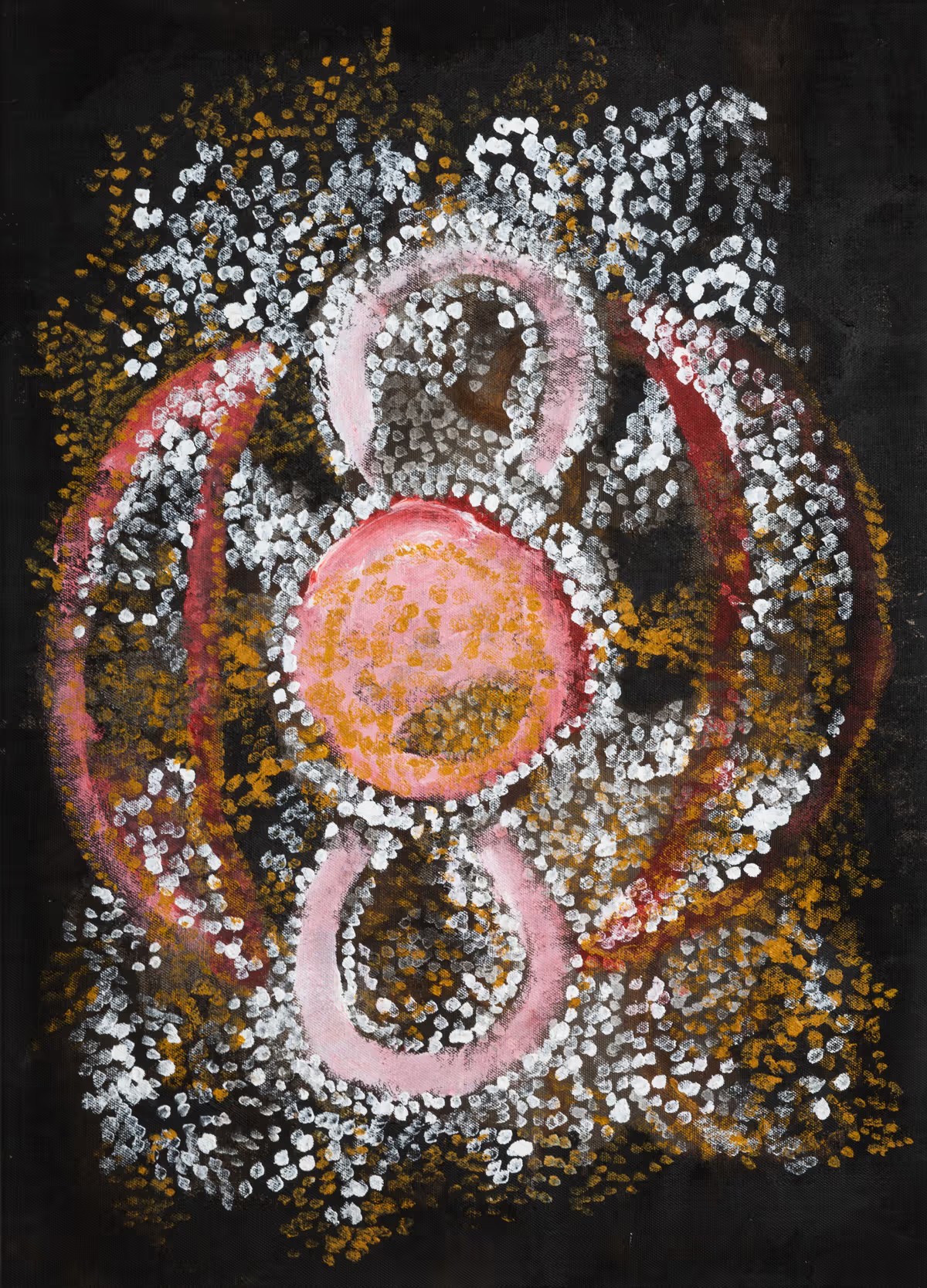
Jinjimarlumarlu Kujjurr, 2023
(shared with approval by the artist)
Artist: Joseph William Jungurayi
Acrylic On Linen
97 x 68 cm
Represented by: 8 Hele Gallery
Jinjimarlumarlu Kujjurr, 2023 (shared with approval by the artist)
Artist: Joseph William Jungurayi
Acrylic On Linen
97 x 68 cm
Represented by: 8 Hele Gallery